General Studies
Click on a topic to expand
English
The KTA English program focuses on the development of sophisticated critical reading, thinking and writing skills. The multi-leveled course offerings provide a systematic program of instruction through which students broaden their knowledge of literature and literary analysis and develop strong skills in language usage and composition, oral communication, research, and creative expression. Mastery of language, literature and and writing provides the foundation for learning in all disciplines and equips students for success in college, in their chosen professions, and in life.
Writing: The KTA Writing curriculum advances vertically from fundamental writing skills in Grade 9 to cross-curricular writing skills in Grade 12, with emphasis on writing as process at every level. As they move through high school, students gain proficiency in the six discrete traits of effective writing (content, organization, sentence fluency, word choice, voice, and conventions) and in the increasingly refined implementation of these traits in narrative, descriptive, expository, persuasive and creative writing.
English 9 takes a genre approach to the study of literature, with an emphasis on critical reading and analytical and creative writing. Readings include novels and plays, as well as short stories and poetry. In addition to novels read in completion and emphasizes more extensive primary readings, as well as short stories and poetry drawn from The Norton Anthology and Sound and Sense. Grammar and vocabulary units prepare students for the PSAT exam. The emphasis in writing is to develop competency in crafting a thesis and supporting it with detail, logical organization, and correct mechanics.
English 10 Academic is an overview of American literature, including novels, poetry, short stories, and non-fiction. Emphasis is placed on the critical reading and analysis of literary texts. Grammar and vocabulary units continue to focus on language usage skills essential for success on the SAT and ACT exams. Writing assignments focus on developing proficiency in the six essential traits of effective writing and writing a research paper.
English 10 Honors is a survey of American literature with a continued emphasis on the development of reading, writing and critical skills. Students gain exposure to literature from the early Colonial Period through the Modern Period, placing each work in historical and social context. Grammar and vocabulary units continue to prepare students for the SAT and ACT exams, while the writing program introduces them to research skills and to the appeals, structure, schemes and tropes of persuasive writing.
English 11 Academic is a chronological survey of British literature including classic works by great writers such as Shakespeare, Austen, and the Bronte sisters. Students read and analyze novels, plays, selected short stories, and poetry, with an emphasis on continued development of critical reading and writing skills. Their interdisciplinary research project is a comparative analysis of a literary and historical figure in Shakespearean literature. Grammar and vocabulary units continue to prepare students for the SAT and ACT. The writing program emphasizes preparation for the writing sections of these exams, refinement of the six traits of effective writing, and developing a thesis or central idea with appropriate support.
Advanced Placement English Literature and Composition 11 is a challenging, college-level course that teaches high school students how to perform active, close reading of literary works and articulate their interpretations through writing and discussion. Students learn to analyze fiction, poetry, and drama from different cultures and periods, focusing on literary elements like character, setting, structure, figurative language, and theme to understand a work’s cultural significance and develop sophisticated analytical arguments. The course culminates in a national exam that assesses these analytical and writing skills.
English 12 Academic is a writing intensive course that focuses on rhetoric and preparing students for college level writing. Readings are drawn primarily from The Norton Sampler and The Bedford Reader, and class discussions focus on accurate understanding and critical analysis of written texts. Research and writing assignments focus on crafting essays utilizing the five modes of discourse. Through the process of reading, writing and revising, each student’s distinctive voice emerges, along with a forceful style and clear sense of audience.
English 12 Honors is a dual enrollment course given in conjunction with Gratz College. The first semester English Composition I introductory course builds fundamental writing and critical thinking skills, focusing on the structure of effective essays, grammar, style, and the basic principles of argumentation, often through analyzing various texts. English Composition II builds upon these foundations by requiring more advanced research skills and potentially introducing rhetorical and persuasive strategies, literary analysis, or professional writing, preparing students for complex academic and professional writing demands across the curriculum.
Advanced Placement English Language and Composition 12 is a writing intensive college-level course in which students gain extensive exposure to modern and historical works of non-fiction, including narratives and works of exposition and persuasion. Writing assignments require rhetorical analysis of the texts and the creation of discourse in response to the readings.
Mathematics
Algebra I introduces students to problem solving techniques utilizing variables. Topics include order of operations, substitution, polynomials and exponents, solving linear equations and inequalities, using factoring to solve quadratic equations, graphing on a coordinate plane, interpreting graphs and solving systems of equations.
Geometry focuses on the study of points, lines and planes and their relationship to each other in space, as well as the properties and quantitative characteristics of shapes such as triangles, polygons, quadrilaterals and circles. Students learn how to use logic and inductive reasoning to prove whether or not certain relationships are true.
Algebra II extends and further develops students’ knowledge of algebra and its applications, including the ability to use mathematical symbols to solve a wide variety of problems. In the Trigonometry part of the course, students study the relationship between the sides and angles of a triangle with an emphasis on problem solving. They are also introduced to topics in analytical geometry, variation and polynomial equations, and logarithms.
Pre-Calculus students go beyond basic algebra and trigonometry, using real world applications to solve advanced problems. Topics covered include real and complex numbers, functions, series and sequence, matrices, probability and statistics and applications of trigonometry. The course also provides students with an introduction to differential calculus.
Advanced Placement Calculus AB is a college level introduction to calculus. Derivative and integral rules are learned and applied to families of functions studied in earlier mathematics courses. Students learn to use calculus techniques to solve problems drawn from physics, economics, solid and analytical geometry and other fields. Examples of applications of the calculus include area and volume, fluid force, vertical motion, sophisticated graphing, length and surface area, growth and decay, max and minima and related rates.
In Consumer Math, students gain practical math competence in areas such as money management, budgeting for groceries and housing, banking, credit, career choices, consumerism, and jobs.
Financial Literacy is a Personal Finance dual enrollment elective for high school juniors. The course provides students with essential skills for managing their money, covering topics like creating budgets, understanding credit and debt, saving for future goals, making informed investment choices, and navigating insurance options. The course aims to empower students to make sound financial decisions, avoid common financial pitfalls such as excessive debt, and build a foundation for long-term financial security and wealth accumulation both during and after their college years.
Science
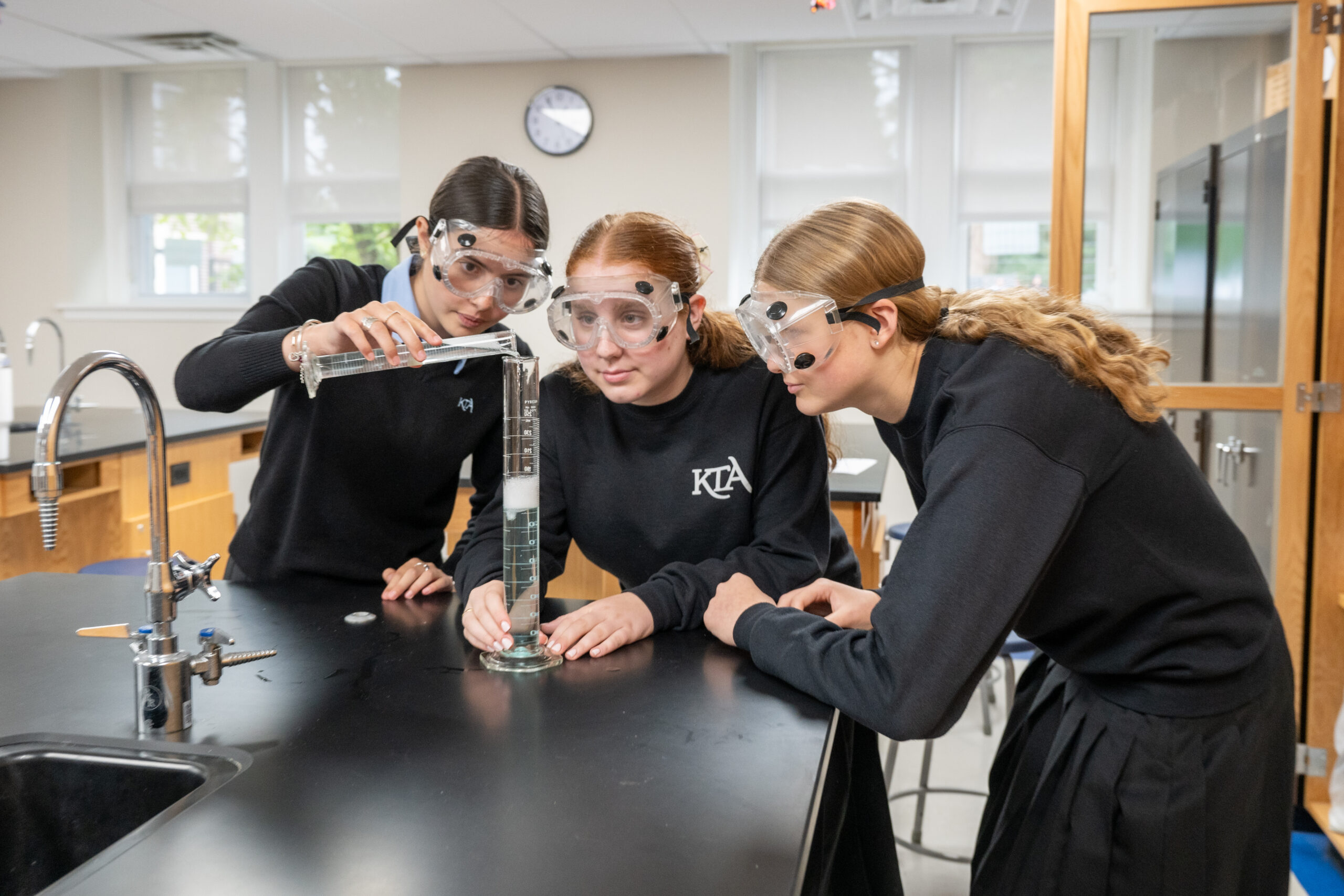
Science instruction at KTA is inquiry based, and encourages students to approach science as a way of thinking about natural phenomena with precision, reasoning, testable predictions, and problem solving based on research and experimentation. The lab based study of physical science, biology, and chemistry at KTA prepares students for advanced scholarship in the sciences in college, and for careers in science, technology, and healthcare. All courses include a science writing and literacy component. In addition, the goal of the science program is to give students the broad fund of scientific knowledge and the critical thinking skills that will enable them to understand new advances in science and technology, appreciate the implications of technological innovations, participate intelligently in discussions of science and public policy, and make informed choices about scientific issues that affect their daily lives.
Physical Science (Grade 9, Academic and Honors) introduces students to the principles that describe our physical universe, with an emphasis on conceptual reasoning and understanding. Topics include vibrations and waves, sound, light, color, electricity, magnetism, and selected topics in mechanics and special relativity. Learning is enhanced with many demonstrations, both live and on video, and each unit is accompanied by lab experiments that give students hands-on learning experience. The physics lab is equipped with Vernier data gathering sensors and software that allows students to measure and collect data in real time and to analyze the data using the same software.
Chemistry (Grade 10, Academic and Honors) focuses on the principles and properties of matter and the interplay between matter, energy and change. Topics include classification and properties of matter, particle masses, compounds, atomic structure, the Periodic Table, bonding, molecular structure, solids, liquids, gasses, energy, reactions, chemical equilibrium, electrochemistry and some organic chemistry. Students gain proficiency and confidence using the lab equipment, techniques and methods of analysis that they will encounter in college chemistry.
Biology (Grade 11, Academic and Honors) is an overview of the basics of life at the cellular, organism and population levels. The course begins with the smallest compounds in a cell and culminates in the study of organ systems in complex organisms. Laboratory skills are practiced and emphasized, and live specimen and virtual dissections are highlights of the course.
Electives (depending upon student interest):
Advanced Placement Biology offers high school seniors the opportunity to study Biology at a college level and to earn college credit. Topics include cell structure and function, mitosis, meiosis, molecular processes in cells (enzyme functions, photosynthesis, cellular respiration, DNA structure, protein syntheses, etc.), classification of organisms, plant and animal structure and systems, and basic concepts of human development, genetics and evolution. The course is fast paced, and requires a great deal of lab work and independent study.
Advanced Placement Chemistry is the equivalent of an introductory General Chemistry course in college, both conceptually and in the laboratory. Topics including the structure of matter, kinetic theory of gasses, chemical equilibriums, chemical kinetics, and basic concepts of thermodynamics are explored in considerable depth and accompanied by extensive lab experience. Students are challenged to work at attaining a depth of understanding of the fundamentals of chemistry, as well as a reasonable level of competence in dealing with chemical problems.
Anatomy and Physiology is a dual enrollment natural science course that teaches the principles of human anatomy and physiology. It emphasizes structural and functional relationships within the human body and mechanisms for maintaining internal stability. The course explores the gross and microscopic study of structure as well as important concepts in molecular physiology. Organ systems and their essential interaction with other body systems are stressed. The relevancy of the subject matter is reinforced by training students to read, understand, interpret and present research findings on topical issues from the relevant peer reviewed scientific literature.
Nutrition, a dual enrollment course open to juniors, studies modern nutrition and its impact on health. Topics include digestion and absorption of nutrients, carbohydrates, fat, protein, vitamin and mineral requirements, additives, food fads, diets, assessment of nutritional status in individuals and populations; and world hunger. Emphasis is placed on the importance of nutrition through the life cycle and the rationale for the development of dietary guidelines. The course provides an integrated overview of the physiological requirements and functions of nutrients that are determinants of health and disease. Through the use of case studies and student presentations, the course examines dietary sources, intake levels, biological determinants of nutrient requirements; and the role of diet on the development of chronic diseases, such as cardiovascular disease, cancer, diabetes, osteoporosis, and arthritis.
Advanced Placement Computer Science Principles is a foundational, college-level introductory course that explores the broad field of computer science by focusing on computational thinking, data analysis, and the creative and collaborative development of algorithms and programs. The course teaches students how computing systems work and their potential impacts on society, encouraging them to analyze problems and design creative, ethical, and collaborative solutions through hands-on projects and discussions on topics like cybersecurity and the internet.
History
The goal of the history curriculum at KTA is to engage the student’s interest in the study of the past, and to stimulate the development of critical thinking and historical perspective. Although courses in the history department cover a wide range of topics and a vast time span, they are characterized by unifying themes that provide a conceptual framework for analyzing the development of modern society. In every course, students are challenged to think independently, to strengthen their critical reading and expository writing skills, to develop skill in historical research through the analysis of primary and secondary texts and to make connections between the past and the present.
Modern European History (Grade 9) traces Europe’s transformation from the late Middle Ages, marked by religious and political centralization, through the Age of Exploration’s global expansion and the subsequent Age of Enlightenment, leading to the Industrial Revolution and the Age of Revolutions that reshaped societies and states. The 20th century brought two World Wars and the Cold War, followed by the European integration of the European community and the fall of communism.
United States History I (Grade 10 Academic) examines the foundations of the American nation, from the Ages of Exploration, through the colonial period of the American Revolution, and the ratification of the Constitution and its implementation in the Federalist period. Students trace the development of American nationhood in the antebellum period, and end the year with a study of the causes and consequences of the Civil War. Exposure to primary documents, secondary texts, historical fiction and documentary videos all help broaden and deepen the student’s understanding of this seminal period in our nation’s development
United States History II (Grade 11 Academic) follows sequentially from the tenth grade course. Students in the eleventh grade explore the emergence of the United States as a modern industrial nation in the latter part of the nineteenth century, and its emergence as a world power in the twentieth century. Students continue to develop critical reading and writing skills, as well as skills in conducting a presenting independent historical research.
Advanced Placement Unites States History (Grades 10 & 11) is a rigorous, accelerated college-level course of study which prepares students for the College Board’s Advanced Placement Exam in United States History. Students are challenged to think, read, write and analyze at an advanced level as they explore the major themes and events in American political, social, economic, cultural, intellectual and diplomatic history from the colonial era through the end of the twentieth century.
Modern Jewish History (Grade 12), a dual enrollment course in conjunction with Gratz College, traces Jewish history beginning with Tach Vetat, through the Holocaust and founding of the State of Israel. The educational objectives of the course are two-fold: to familiarize students with the history and chronology of this most tragic period in modern Jewish history, and to guide students in exploring complex and difficult religious and philosophical issues relating to the Holocaust from a Torah perspective.
Fitness and Health
Fitness 9, 10, 11, 12: The KTA fitness program encourages students to develop lifelong habits that promote good health, physical activity and an overall feeling of wellbeing. Fitness classes, which meet twice a week, engage students in a variety of physical fitness activities, including aerobic exercise (kickboxing and dance based aerobics), strength training (working with free weights and utilizing one’s own body weight), and routines that promote flexibility (stretching, yoga). Recognizing that exercise enhances energy and alertness, and thereby improves concentration and learning, the Fitness program provides an opportunity for intense physical activity in the midst of the academic day.
Goals of the Fitness program are to educate students about the underlying physiology of exercise and about how to exercise in a safe and effective way; to encourage a positive feeling about exercise and about the efficacy of physical activity as a healthy antidote to stress; to inspire students to exercise regularly throughout their lives; and to make fitness pleasurable and fun.
Health (Grade 10): This course is designed to address health-related issues that are relevant to our students. A community physician teaches a series of lectures as part of this “Health and Wellness” course. Topics include Understanding Your Medical History; Diet, Nutrition and Eating Disorders; Understanding Your Endocrine System and Everything You Want to Know About Acne; Topics in Mental Health; and Jewish Genetic Diseases.
Humanities and Social Sciences
Ivrit is a two-year sequence in Modern Hebrew Language, with the option of a senior year elective. Two levels of instruction are offered, with a primary emphasis on the development of fluency in conversational Hebrew. Grammar, language usage, and language enrichment are emphasized, as well, with the objective of improving reading comprehension and writing.
Advanced Placement Psychology (Grade 12) is a college-level course designed to introduce students to the systematic and scientific study of the behavior and mental processes of human beings and other animals. Students are exposed to the psychological facts, principles, and phenomena associated with each of the major subfields within psychology. Topics include memory, intelligence, personality development, learning theories and social development. Students design studies to explore their own behavior as well as research specific topics in the course. They also learn about the ethics and methods psychologists use in their science and practice.
Psychology (Grade 12, Academic) is an introductory course that gives students exposure to basic concepts in the study of psychology. Special emphasis is placed on theories of child development, adult development through the life cycle, personality development, and mechanisms for coping and adaptation.
Fundamentals of Art and Design (Grades 9 and 10) is a two-year sequence that introduces students to the basic elements and principles of art and design, which are the building blocks for any work of art. The course combines brief lectures on art concepts and art history with considerable hands on work, including completion of 2D and 3D studio projects. Students create works of art by applying their knowledge of the elements of Art using a variety of fine art media.
Advanced Fine Art 11/12 is an advanced dual enrollment fine arts course that builds on the concepts learned in Fundamentals of Design 9 and 10. Students combine all the elements and principles of design to create works of art using advanced methods in acrylics, watercolors, collage, clay and other mixed media.